Mount Kilimanjaro has drawn adventurers, scientists, and dreamers for over a century. Its glaciers, dramatic landscapes, and status as Africa’s highest peak have inspired some of the most remarkable climbs in mountaineering history.
At Kilisherpas Travel, we have guided thousands of climbers to Uhuru Peak. This 2026/2027 guide highlights five historic climbs that shaped Kilimanjaro’s legacy — from early scientific expeditions to daring first ascents and modern charitable efforts.
1. The Scientist Ahead of the Mountaineers – Fritz Klute (1912)
German glaciologist Fritz Klute is remembered not just for reaching high on Kilimanjaro but for pioneering scientific study of its glaciers. In 1912, he and companion Eduard Oehler conducted one of the first systematic surveys of the mountain’s ice fields using photogrammetry.
While focused on science, Klute also became the first person to summit Mawenzi (5,149 m / 16,893 ft), the rugged second peak of the Kilimanjaro massif. Their route via the saddle between Kibo and Mawenzi was extremely challenging, involving steep slopes, rocks, and ice.
Klute’s work provided early evidence of the rapid shrinking of Kilimanjaro’s glaciers and raised awareness about their vulnerability. His detailed maps and observations remain foundational in African glaciology.
In 2024, previously thought-lost field notes and photo albums from the expedition were rediscovered in Germany, offering new insights into this pioneering climb.
2. Conquering the Decken Glacier – Fritz Eisenmann & Karl Schnackig (1938)
The Decken Glacier, named after explorer Karl Klaus von der Decken, was long considered one of Kilimanjaro’s most difficult obstacles. Steep, exposed, and prone to rock and ice falls, it had repelled earlier attempts.
In 1938, German climber Fritz Eisenmann and Swiss guide Karl Schnackig succeeded in traversing the glacier. Starting from around 4,650 m, they navigated icefalls and steep slopes to complete the route. Their climb marked a significant milestone in Kilimanjaro mountaineering and demonstrated the technical skill required to tackle its glacial features.
3. The Heim Glacier Expedition – John Cooke, Anton Nelson & David Goodall (1950s)
British explorer John Cooke aimed to complete the first continuous traverse of Kilimanjaro, summiting all three main peaks: Shira, Kibo, and Mawenzi. Accompanied by American Anton Nelson and Briton David Goodall, the team tackled the challenging Heim Glacier on Kibo’s south face.
The route involved steep ice and rock sections. During the ascent, Cooke slipped and dangled upside down over a precipice, saved only by the quick actions of Goodall, who secured the rope. Despite the near-disaster and loss of an ice axe, the team pushed on and completed a significant portion of their ambitious traverse.
Cooke later described the elation of standing on the “roof of the world” with unobstructed views across the vast plains of northern Tanganyika.
4. Scaling to the Summit in 12 Hours – Reinhold Messner (1978)
Legendary Italian mountaineer Reinhold Messner, known for his groundbreaking ascents without supplemental oxygen, turned his attention to Kilimanjaro’s western face. Together with Konrad Renzler, he completed the first ascent via the Breach Wall and Diamond Glacier — a steep, technical route previously considered impassable.
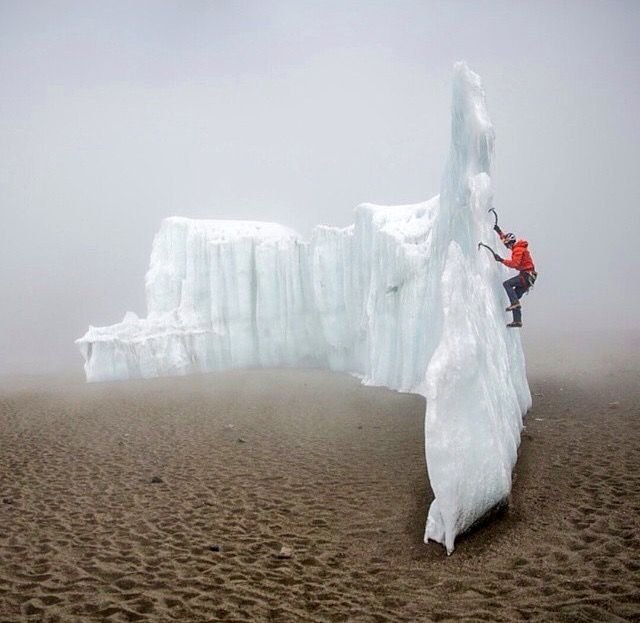
The pair climbed from Arrow Glacier Camp directly up the volcanic rift, navigating icefalls and the 90-metre Breach Wall icicle before traversing the Diamond Glacier to Uhuru Peak. They completed the ascent in just 12 hours.
Messner later described the route as one of his more dangerous climbs, noting the glassy ice and risk of rockfall. His success proved that even Africa’s highest mountain held serious technical challenges worthy of elite mountaineers.
5. “No Place He Would Rather Be Than in the Mountains” – Ian McKeever (2013)
Irish climber and charity organiser Ian McKeever dedicated much of his life to inspiring young people through mountain challenges. He set records for the fastest completion of the Seven Summits and led numerous charitable climbs on Kilimanjaro.
In January 2013, while guiding a group of 20 people (including students and his fiancée) on a charity ascent, McKeever was struck and killed by lightning near Lava Tower at around 4,000 m. The tragic accident occurred during a sudden thunderstorm.
McKeever’s legacy lives on through the Kilimanjaro Achievers organisation and the Ian McKeever Children’s Home, which continue his mission of providing life-changing mountain experiences for children.
Why These Historic Climbs Matter
These stories illustrate the evolution of mountaineering on Kilimanjaro — from early scientific exploration and daring first ascents to modern charitable and inclusive efforts. They highlight the mountain’s enduring power to inspire, challenge, and unite people across generations and abilities.
Today, Kilimanjaro remains accessible to climbers of varying experience levels, provided they prepare properly and climb with reputable operators.
Plan Your Own Historic Climb with Kilisherpas Travel
Whether you dream of a classic route, a technical challenge, or an inclusive expedition, we provide expert guidance, safety-focused support, and personalised itineraries.
Our team has guided climbers with diverse backgrounds and abilities to Uhuru Peak. We emphasise proper acclimatisation, safety protocols, and respect for the mountain’s fragile environment.
Ready to add your name to Kilimanjaro’s history?
Contact Kilisherpas Travel today to plan your 2026/2027 Kilimanjaro expedition. Let us help you create a safe, successful, and unforgettable climb.