The Amazing True Story of the Kilimanjaro Leopard: Fact, Myth, and Mystery
Kilimanjaro, Africa’s tallest mountain, is renowned for its breathtaking glaciers, diverse ecosystems, and awe-inspiring landscapes. But it also harbours intriguing legends and mysterious discoveries that capture the imagination of adventurers and scientists alike. Among these stories, the tale of a frozen leopard found on Kilimanjaro’s summit stands out as one of the most fascinating and debated. Was it a myth, a Hemingway invention, or a remarkable real event? In this article, Kilisherpas Travel delves into the captivating history, scientific insights, and ongoing mysteries surrounding the legendary Kilimanjaro leopard.
The Origin of the Kilimanjaro Leopard: Hemingway’s Inspiration or Reality?
The Literary Connection
In 1936, renowned American author Ernest Hemingway published his short story The Snows of Kilimanjaro in Esquire magazine. The opening paragraph vividly describes a frozen leopard lying in the snow at the mountain’s summit:
Kilimanjaro is a snow-covered mountain 19,710 feet high and is said to be the highest mountain in Africa. Its western summit is called the Masai 'Ngàje Ngài', the House of God. Close to the western summit, there is the dried and frozen carcass of a leopard. No one has explained what the leopard was seeking at that altitude."
This evocative image has fuelled speculation for decades. But what is the truth behind Hemingway’s description? Was he recounting a real event, or was it a literary device?
The Discovery of the Frozen Leopard
Historical records confirm that a frozen leopard carcass was indeed discovered in the 1920s on Kilimanjaro. The animal was found at an elevation of roughly 5,640 meters (about 18,500 feet), a rare and extreme altitude for a predator like a leopard. The carcass was remarkably well-preserved due to the freezing conditions, sparking intrigue and awe among early explorers.
The Pioneers and the Discoveries
Richard Reusch: The Adventurous Mountaineer
One of the key figures in this story is Richard Reusch, a German-born mountaineer and missionary who spent years exploring Kilimanjaro. Reusch was known for his passionate climbs—believed to be at least 40, possibly up to 65—and he was instrumental in documenting many of his discoveries.
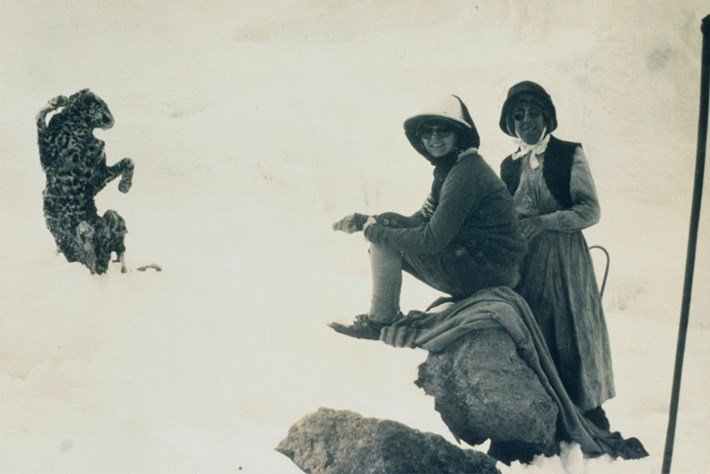
In 1926, during his ascent, Reusch became the first known person to reach Uhuru Peak and reportedly found the mummified carcass of the leopard. He captured a photograph showing the animal’s curled-up body alongside explorer Elisabeth Müller, one of the early female climbers. Reusch also discovered a frozen antelope nearby—an important piece in understanding the leopard’s presence.
The Fate of the Leopard
Reusch believed the leopard was following the antelope, which likely wandered to high elevations seeking salt from mineral deposits. According to his theory, a snowstorm struck, trapping and killing both animals. The extreme altitude—where oxygen levels are roughly half that of sea level—would have made survival impossible for such predators and prey.
Reusch and his team moved the carcass to a visible spot, but over subsequent expeditions, the carcass disappeared, leaving its final resting place forever a mystery. Some speculate it was removed or scavenged, fuelling legends that the leopard’s remains were lost forever.
Other High-Altitude Animal Discoveries
Leopards and Other Creatures on Kilimanjaro
The story of the Kilimanjaro leopard is not isolated. Hans Meyer, the first person to summit Kilimanjaro in 1889, reported finding leopard remains at high elevations near the saddle between Kibo and Mawenzi.
In addition, in 1962, climbers spotted a small pack of five African wild dogs at nearly 4,900 meters (16,076 feet). Today, animals such as antelopes, buffalo, wild dogs, servals, and even elephants are occasionally seen on the mountain’s plateau and remote areas, especially on less-travelled routes like the Shira Plateau.
Mount Kenya and Other High-Altitude Discoveries
Interestingly, similar findings have been made on Mount Kenya. In 1997, scientists uncovered a leopard carcass protruding from the Tyndall Glacier at 4,390 meters (14,403 feet). Radiocarbon dating revealed the animal was around 900 years old, indicating that high-altitude animal carcasses are not unique to Kilimanjaro and have fascinated researchers for decades.
The Mystery Continues: Why Do Animals End Up at Such Altitudes?
Natural Behavior and Adaptation
How do animals like leopards and antelopes reach these staggering heights? Some hypotheses suggest that animals climb seeking salt and other mineral deposits, or in response to predator threats. Leopards are known for their remarkable climbing ability, with the highest confirmed altitude for a leopard being 5,200 meters (17,060 feet)—still below the supposed location of the Kilimanjaro leopard.
Glacial Discoveries and Ongoing Mysteries
Today, glaciologists studying Kilimanjaro’s glaciers continue to find animal remains, including monkeys, antelopes, and bushpigs, frozen at altitudes nearing 6,000 meters (approximately 19,685 feet). These discoveries raise questions about animal migration patterns and the mountain’s changing climate.
Conclusion
The story of the Kilimanjaro leopard remains one of the most captivating mysteries of Africa’s highest peak. From Hemingway’s literary masterpiece to scientific discoveries, the tale blends legend, adventure, and scientific intrigue. While we may never fully understand how these animals reached such extreme altitudes, their frozen remains continue to inspire curiosity and wonder.
Are you fascinated by mountain mysteries? Stay tuned with Kilisherpas Travel for more incredible stories from Africa’s highest peaks.